Personal
Broken Trades Chapter 1 - "I Made a Million Dollars!"
Dec 31, 2003
To celebrate Josh's Birthday this year, I thought I should resurface the first chapter of the book I wrote about Datek Online. Most of the book is quite dry, describing the business and technology innovations that enabled Jeff, Josh, and I to build one of the largest retail brokerage firms from scratch in about a year, and about we changed how the stock market operated as a result.
Some chapters are outright boring unless you are stock market nerd-historian. Some chapters are quite sad. Chapter 1 is the most enjoyable one.
50 Broad Street
One block south of the New York Stock Exchange
July 1995
I stand in a small room, lit by dim neon light framed by sagging drop ceiling panels. My right foot is on the rayon office carpet, filthy with years of dust and General Tso’s sauce stains. My left foot is on a pile of old computer magazines. Standing gives me a better view of what is happening on the array of monitors lining the metal baker’s rack that fills most of the room. Standing lets me hear more of what is said, over the shouting, grunting, and frantic klackety-klack of traders’ keyboards. Mostly, though, I stand because there is nowhere to sit.
To state that this narrow little space is crowded would be a comic understatement. In addition to the massive baker’s rack stretching the length of the room from floor to ceiling, there is a worn folding table capped in chipped, wood colored plastic pinning the baker’s rack against the wall, curving under the weight of too many computers, CRT monitors, and network gear. Two office chairs face the folding table and rack, currently occupied by Anthony and Tommy. An over-sized leather chair faces the opposite direction, towards a wooden desk with actual drawers; desk drawers are not allowed anywhere on the floor.
Jeff, Josh, and I also fit in there.
It’s a lot of stuff and bodies to fit in a room no bigger than a walk-in closet.
There is a small window at the far end of the room. The window is grimy the way only NYC alley-windows can get after decades without cleaning, a patina of grayness so rich you’d think the glass is colored that way. An antique oscilloscope and odd bits of electrical gear are piled at the window-end of the folding table, equipment or detritus from Josh’s latest experiments depending on your point of view. Crumpled trading tickets, pages ripped out of computer and science magazines, soiled paper napkins, and other debris are everywhere: on the floor, stuffed between bulky cathode ray monitors and on every horizontal surface. is
A knee-high pile of junk mail, computer magazines, NASDR notices, and financial newspapers blocks most of the entrance. Originally waist-high, the pile was stacked against the doorframe but fell over a long time ago. Now we all stand on paper. The slick covers of yellowing tech magazines shift unexpectedly when you walk, like climbing on mountain scree. Computer cables drape from missing squares in the drop ceiling head towards obscure connectors behind the baker’s rack. It smells of dust, old shoes, ozone from CRT displays and computers, and used cooking oil from the fried chicken joint in the alley ten floors below.
Jeff sits in the leather chair with his feet up on the desk. It’s a commanding position, indicative of Jeff’s stature. Or rather, it would be a commanding position if Jeff weren’t so big and the room not so cramped. He must fold forward awkwardly to fit in the leather chair and avoid leaning his head on Anthony’s back who faces the other way. He has to get up anytime someone wants to get by, like a large guy in the middle seat on a full flight in coach.
Multi-colored lines of alpha-numerics scroll by on the bulky cathode-ray monitors. The displays are old-school, text-only displays, no windows or graphics. Some of the text corresponds to stock symbols and prices but most monitors are scrolling too fast to read. It is indecipherable to me but it all means something to Jeff and Josh. They don’t miss anything on those monitors, without even seeming to look.
I have been standing in this office for three weeks from an hour before the stock market open at 9:30 am until an hour after the closing bell at 4:00 pm, but only in the last few days has any of the displays or what happens in this room started to make sense.
Jeff has been trying to teach me trading jargon and the mechanics of stock trading. He interrupts me throughout the day and, pointing, at one of the two-dozen computer monitors on the rack, barks out questions in fast staccato trader talk. He might as well be speaking Finnish. When my face remains blank, he treats me like a stroke victim and speaks in what is, to me, normal-speed English so I can try to answer.
Anthony, always on the lookout for ways to torment the new guy, snickers and makes snide comments to Tommy when I get the answers wrong. It’s easy to ignore Anthony making fun of me. I got picked on a lot in middle school. Maybe not by shaved headed, tattooed, big, muscled neo-Nazis with heavy Staten Island accents, but if I got through middle school, I can take the abuse here.
Most of it, anyway.
It is much harder to ignore Anthony’s colorful descriptions of what my girlfriend is doing with her boss on her business trip. When you work in a closet with four other people it’s hard to keep details of your personal life to yourself.
Anthony has a wonderful imagination. He vigorously applies it to pissing people off.
For the last few weeks, I have been crashing on Josh’s couch in his nearby apartment, spending almost every waking hour in this little room or the adjacent rooms, staring at scrolling text, immersing myself in this world of stock trading. Jeff can no longer stump me with the simplest of questions.
“What price can I buy this stock at?”
“Is this stock going up or down?”
“Who is on the offer?”
“How much size is there on the offer?”
Before leaving my previous job in a distant city with its spacious, modern décor, with floor-to-ceiling windows, views of trees and grass and sky, to come to work in this closet, I had read a stack of popular books on investing in the stock market. Those books, outlining the strategies of famous investors like George Soros, Warren Buffet, or their various authors, described the investing world like how you see it on TV or read about in newspapers. They described value stocks, growth stocks, revenue, dividends, cost structures. They list how to identify quality management teams and products or analyze how important events impact the price of stocks in various sectors.
Those books describe a world of causality. Something happens in the world, and subsequently something changes in the stock market If you respond intelligently then you can make money by buying and selling shares in publicly traded companies.
Nothing like that is happening here in this room.
Jeff seems to pick stocks to trade at random. There are thousands of stocks trading on NASDAQ, but he senses which ones he can make money in, second by second. He reads the market from all those scrolling numbers and just feels when he can make money. With a single keystroke he makes a $100,000 investment in Microsoft, and with another keystroke he sells out the investment for $105,000 less than a minute later. He often does this a few times in a row, talking out loud about what he is doing to make a show of how easy it is. In 15 minutes on a busy day in the market he can earn more than my annual salary. He somehow feels that Microsoft or Oracle or Cisco would go up in the next minute, not down, and hits a few keys to take advantage of that feeling.
Often Jeff does not know the names of the companies he is investing in. Nor do Tommy or Anthony or any of the traders in our offices. They don’t have to. They just need the real-time numbers representing trading activity, labeled by a 4 or 5 character stock symbol. Since they don’t know the names, they don’t know the industries, they are obviously not making trading decisions based on anything in those books I read.
Unlike every other trading floor in New York City, perhaps in the world, there are no Bloomberg terminal, no TVs tuned to the financial news. Jeff’s insights come directly from the market itself, via the scrolling characters in coded text messages.
Nothing happens fast enough to satisfy Jeff. Jeff is fast. He thinks fast, he walks fast, he reaches for a phone fast. At twenty-three, he is always in a rush. He acts like the world might end at any moment, at least during trading hours.
In the next room, a real room, not a closet, rows of folding tables support desktop computers for sixteen traders, in two rows of eight, facing each other. There is barely enough room to squeeze behind them to get from the hallway to our closet.
The traders stare intently at their monitors, pounding on their keyboards in sudden bursts, seemingly at random. There is a melody to the rise and fall of traders typing. That melody is the sound of traders making money.
Yellowing issues of Investor’s Business Daily, food wrappers, those ubiquitous blue and white NYC -style coffee cups, broken keyboards, old running shoes, and the coax network cables litter the floor, the windowsills, everywhere. The garbage is at its thickest between the center of the two rows of card tables, where the cables pool behind the computers. This is unfortunate, because one of my many unpleasant tasks is to track down network failures. The leading cause of network failures is a trader’s foot lashing out to strike both garbage and network cable.
It would be a cleaning lady’s nightmare, but no cleaning staff is allowed in these rooms. They would break the network.
It took years of careful neglect to soil this place.
Past this trading room there are other rooms just like it, interconnected in a maze, all containing the same cheap and worn furniture, battered desktop computers with bulky cathode ray monitors, food wrappers, and trading trash. Where a particular trader sits changes almost daily. The constant activity and change make hard for me to keep my bearings, as if the rooms themselves change position every day.
These traders are a close-knit group. They have been working together for years. Everybody got their jobs through a personal contact: someone they know, a brother, a neighbor, a classmate asked them to take a shot at becoming a day trader.
I am the only person in the office who is not a trader. I will never be a trader. It is an important stipulation in my verbal employment agreement.
“You are not being hired to be a trader. We are hiring you to be a computer guy, to help Josh with the computer stuff. Don’t ever ask to be a trader. It might look like fun. It might look like you will make a lot of money. You probably would. But we can’t have everyone who shows up here begging to be a trader, so don’t even ask” Jeff had told me the day of my job interview. Josh stood behind Jeff, nodding his head, his eyes wide open, a slight frown, implying being a trader was the worst possible thing ever.
It was ok. I didn’t think I wanted to be a trader.
Now that I have been at my new job for a few weeks, trading has some clear advantages over tending to the traders’ computers. Young people from Staten Island, unshaven, under-dressed, not at all playing the role of Wall Street professionals, were intently pounding on keyboards for six and half hours a day and making more money in a week than I would see in a year. With the naiveté of someone who recently showed up, it looks easy. I feel a growing bitterness at having to crawl in the dirt, literally, underneath folding tables to find the disconnected segments of network cables kicked out by excited, sloppy high school dropouts who dine at New York’s finest restaurants and rent beachfront homes at the Jersey shore or out in the Hamptons.
Several times a day I wonder what I am doing here. I question why I left comfortable work that I enjoyed, that I was good at, work for which I had gone to college, for this awkward, confusing, chaotic, and mostly unpleasant situation.
It’s a weird situation, but Jeff and Josh’s closet is definitely not boring. The traders are mostly nice. Anybody who can fix their computers when they break is somebody they want on their side. A crashed computer means they can’t make money. Traders abhor missing out on trading opportunities during trading hours. But these guys are mostly affable anyway, even if I was not there to fix their computers. Except for Anthony. And Jay the screamer…
There is one room where I am scared to go. It’s a separate room from the rest. You must leave our interconnected set of rooms and go down the narrow, gray hallway of our 19th century skyscraper, toward the bathrooms at the end of the hall to get there.
Down the hallway in a separate room is where they put Jay and the other “screamers.” Nobody likes to work with the screamers. Their screaming is distracting. Screaming impairs peoples’ concentration.
Screamers are traders who can’t control their screams of rage when trades don’t go their way. They sometimes smash things. Phones. Keyboards. Monitors. Then they call me to fix stuff, so they can get back to trading. I worry they are going to smash me, too. The broken devices get stacked high on the windowsill in their room, like a monument or a warning.
Despite my fear and envy, I admire these guys. They come from nowhere special. We are a few dozen yards south of Wall Street but there are no suits here, no ties, no Ivy League graduates. They did not excel at school or come from influential families. These kids have no special analytical skills that you can measure with a standardized test. Put them in front of one of these magical day-trading terminals, add a little training from their best friend, and watch they make money. A fraternity of unlikely soon-to-be millionaires is forming day by day.
Their appreciation of their good fortune is clear from their happy demeanor and good spirits, when they are not concentrating on trading. Even the screamers are pleasant and jovial, mostly, just not during trading hours.
My first night in New York City, Jeff and his girlfriend took me out to a trendy East Village sushi joint. Jeff was approachable and social, even if he encouraged me to drink so much sake that I was on the verge of vomiting on my first day in the office. As charming and as gregarious as Jeff was that night, during trading hours in the office he is tense. There is a seriousness, an intensity to him far beyond his years, far beyond anything I have ever seen in anyone, ever.
Jeff made this all happen, somehow. Jeff is big. He towers over an average person like me, but he his presence that does not come from mere physical size. When Jeff walks by, traders check their P&L, their profit and loss numbers, make sure they are not past their capital limits, making sure they are doing everything as they have been told. You do not want to get called out by Jeff.
The traders respect Jeff. Or maybe they fear him.
In my short time in NYC I have already seen Jeff, furious at a trader for trading past some capital limit, make him wear a giant dunce cap hastily made from newspaper and duct tape. I have seen people duct-taped to a chair for the day. I have seen people forced to eat extra soup from the Soup Nazi.
Traders show up at their desks ready for the market open, and trade until the market close. Train delays, flooding in your apartment, doctors’ appointments are not allowed to impact that. Trades do not want to attract Jeff’s attention by not being ready for the market open or for a trading mistake.
Nobody is afraid of Josh, whom everyone adores. Josh is no less intense than Jeff, but quieter and smaller. Josh is helpful to a fault. Josh rarely enters 50 Broad or his apartment building without bringing the doormen soft drinks or burritos. He leaves ridiculously large tips at restaurants that he will never return to. He helps everyone with their computer problems, no matter how silly the problem, speaking in a calm voice even if they call when everything is going crazy. Josh never says “no” to anyone. Unlike everyone else around the office, Josh never raises his voice or uses foul language.
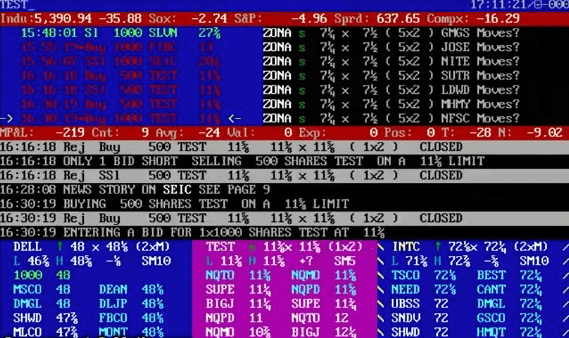
Josh [JG1] is the genius that created Watcher, the trading terminal that everyone is typing on, and making tons of money doing it.
Watcher is the most enabling technology to hit the equities markets since… probably since the existence of equity trading markets. Watcher lets these guys view a quote for a stock and enter an order faster than any other traders on NASDAQ, just by hitting a single key on the keyboard. There is no faster system for trading NASDAQ stocks than the Watcher.
The Watcher display is ugly. It is an antiquated text-only screen with some colored boxes in the background. In this modern post-Windows 95 era, Watcher looks simplistic and antiquated. It runs on old PCs, using out-of-date and almost extinct operating systems and programming environments. A Watcher screen like the display used to track your laundry at your neighborhood dry-cleaner.
That is not a coincidence. The only place you can find the software behind Watcher is at your neighborhood dry-cleaner.
I had just left a career where I used the newest, fastest, most expensive, cutting-edge tech that hardly anyone had access to or even knew about. Now I work with software that is out-of-date at a neighborhood laundromat. Another reason to question what I am doing here.
Outside of these offices, hardly anyone has heard of Watcher. The few that have heard of it do not understand what it is. That does not matter. Watcher is going to change the world of stock trading.
No one knows that yet, except Josh and Jeff. They know it. It’s pretty much all they talk about.
Trading faster is critical to what these guys do. Trading faster is all they do. Their style of trading is like a gun duel or running from a lion. It doesn’t matter how fast you are in absolute terms. You win it all if you are just a little bit faster than the other guy. The other guy loses everything.
This is called “day-trading”, because these guys try not to hold a stock position overnight. They try not to hold a position for more than a few minutes. A few seconds suits them just fine. The longer you wait to get out of position, the more likely it will move against you. Holding a position overnight? That is reckless: tomorrow’s opening price could move against you a lot. And who wants to start the day unwinding some random call from yesterday’s call to get back below your trading limits to make a new trade?
The Watcher is a very elaborate trading system. The displays and keyboards in front of the traders are just the tip of a giant iceberg of interconnected computer systems. What the traders don’t see, far below the waterline, is the largest collection of data feeds anywhere on NASDAQ, along with the computers and networking gear that connect those feeds to the Watcher desktop terminals. This datacom hub is probably the highest capacity quote plant outside of NASDAQ’s data center in Stratford, Connecticut, but unlike that one, Watcher’s data center, if you were to call it that, is hard to find. It’s past a door behind a pile of pizza boxes and NASDR binders, on your left as you come in from the hallway. I put the pizza boxes there to stop people from confusing that door with the bathroom.
Josh is six months younger than I am, twenty-six, and a few years older than Jeff. We are all young enough that a few years still make a difference in how we compare with each other. With his clean-shaven, round, friendly face and short curly hair Josh looks younger than he is. He is almost exactly my height, perfectly average. Nothing exceptional about his appearance, except for his eyes. His eyes burn with an intense excitement that I find exhausting.
I have known Josh since my freshman year of college. I was doing homework in my cinderblock dorm room that could be confused for a prison cell except for the lack of a bathroom. I was startled by a loud “THFWOOOT” sound, followed by cheering. A few minutes later it happened again, louder this time. After the third time I went up to the roof.
Josh was holding a giant tube, standing at the center of a large crowd of onlookers. He was firing tennis balls out of a home-made butane-powered cannon. Instead of going to class or doing homework he had built the cannon from instructions found in a magazine. Flaming tennis balls were sent flying over the adjacent dorm and across the football field, bouncing off cars in a distant parking lot.
What had I accomplished that day? Practicing a new technique for calculating the integral of some trig function to appease some professor I would never speak to again after the semester was over.
Josh loved to learn but found school silly, so he skipped classes he didn’t like to work on his own projects like tennis ball cannons. His professors were frustrated at his habit of answering elaborate problems correctly on tests without showing any work, figuring out the answer in his head using some novel trick he had just made up. While I was struggling with mindless equations, not really understanding anything, Josh would be in his dorm room coiling wires and building circuits to teach himself electronics without all that math. Josh used his coiled wires to record music by wire-tapping speaker cables in the dorm room next door – through the wall. I never figured out anything useful to do with coiled wires, but I could regurgitate some math to describe what happens when you run an alternating current through them.
Josh showed up sophomore year, went to classes but left college during the first half of sophomore year. He did not fail out, but he was not paying for classes, so he simply left. I would not see him again for many years, when he had already become famous and rich by creating software for Wall Street years before that was a cool idea.
If you really want to know something, something technical, you asked Josh. He can’t help but learn the things he wants to learn, and learn them very deeply. This is often irritating. Sometimes people don’t want to know that much.
A few days before, Josh and I had spent the afternoon in the bathroom down the hall, past the screamers’ room, working on a digital waterfall.
“Come on Petey! You know tap water is ionized; it holds a charge as it comes out of the faucet! You must know how to use a high voltage field to move a trickle of water. You went to college! You must know this stuff!” I did not know any of this stuff.
Josh had ordered some high voltage power converters from the back of a magazine. While I stood on the sink, holding a hose and dribbling water through a flattened tin foil funnel, Josh turned the voltage generators on and off. I prayed the 10,000 volts wouldn’t hurt me much when I got electrocuted.
The crazy thing was this worked. You can move a stream of ordinary tap water back and forth with a lot of volts. Josh was very excited. He could not stop talking about how he would build a ten-story high digital waterfall that could show images and animations in streams of falling water down the side of a skyscraper.
After four years at a top engineering school, I did not understand anything as well as Josh. I somehow missed all the classes that described how tap water becomes ionized as it moves through copper pipes, and how to build electronics to take advantage of that.
It is fun to hang with people much smarter than yourself. It is also discouraging to realize you will never be that smart.
Josh and I started planning how we could control a building-sized digital waterfall, designing the circuitry to switch the voltages we would need while not frying the computer it was connected to. Was this really part of my new Wall Street job? It was not trading, certainly. Still, it did not seem to be how I should be spending my time during trading hours.
Jeff found us in the bathroom, me standing on the sink and Josh kneeling down over some equipment. He yelled at me to get back to work. With Josh, he gently cajoled him back to work.
Jeff is often irritated by Josh’s distracting projects. How can Josh spend so much time on digital waterfalls, spinning LED displays, or talking music boxes when he could be improving the Watcher, and helping everyone make more money?
“Jeff does not appreciate digital waterfalls” Josh said sheepishly. He added, “I don’t work like other people. I start something, I stop, I work on something else. I think about other things. I have lots of projects going on at once.” Then he got back to coding new features for Watcher, standing at a keyboard between Anthony and Tommy, typing faster than I could read.
Despite frequent disagreements, Josh and Jeff seem to have a very successful work relationship. They have been growing this… this… business? operation? scheme? I don’t know what it is, but they have been growing it together for a very long time. Five years of more.
I barely know Jeff. He looks boyish, with fleshy cheeks and a big grin, but acts much older than he is. Or tries to. He is very clever, that is obvious, and not just about trading stuff. If you have a physical puzzle, maybe those nails wrapped around each other or those locking concentric discs, just leave it on Jeff’s desk and he will absent-mindedly solve it while doing something else. He is a wiz at all sorts of mental puzzles too. Ask him to find a loop-hole in a legal contract or tax issue, he will have an answer for you in seconds. Or at least a plausible opinion.
Jeff is probably the smartest person in any room he is in. He really is very smart. Unfortunately for anyone in the room, the only person who is not sure of that is Jeff. Jeff likes to be the first person with an answer, so when a question comes up he ends up spitting out words very quickly, interrupting people before they have finished the question. Sometimes there is no question, just a stream of possible answers from Jeff.
I used to be like that with my older cousin when I was ten. My cousin started ignoring me. I was being annoying. I did not want to be ignored, so I tried to stop acting that way.
No one is going to ignore Jeff. He controls who gets a Watcher and who doesn’t.
Jeff talks about things he doesn’t know, can’t possibly know, that nobody could possibly know, with as much conviction as on topics on which he is an undisputed expert.
A few days earlier I had one of my many unsettling Jeff conversations.
“My coffee is cold” I had mused absently, regretting the busy morning that had let my sugary coffee-cart coffee get stale, un-drunken, on the monitor rack. New York coffee-cart coffee is new to me. It’s delicious, bitter, sweet, milky, hot. I am already addicted. It’s a good way to start the day. The year is 1995. Wall Street is a culinary wasteland. You can’t get a decent espresso south of 9th Street.
“I know!” said Jeff emphatically, answering my rhetorical question, staring at me intently. How can he be so intense over my stale coffee?
“What do you mean, ‘you know’? You don’t know that!” I blurt out. I should have kept my mouth shut, but I couldn’t help myself. Is he tasting my coffee? Is he really going to argue that he pays that much attention to my coffee? Making subtle calculations involving the thermal coefficients of coffee cups? Is he really going to insist on having an opinion about the temperature of my coffee?
“I just know!” he answered and left the room. Conversations with Jeff are things to be won or lost. When he gets into a conversation that is unwinnable, he simply leaves.
If I had some more self-confidence this would be fun, this return to elementary school conversations in a work setting.
It’s not fun, though. Everything is too strange. I feel stupid. I am insecure. Josh and Jeff are unnerving. I am starting to fear for my sanity, not that I was ever terribly confident about that either. Every day I think of quitting, just giving up, leaving New York City and making a career change to something normal.
The wildly successful but secretive firm D.E. Shaw has been running interesting job ads in the Wall Street Journal. “Are You a Super Hacker?” is the provocative title on most of them. The word “hacker” does not have positive connotations in 1995. D.E. Shaw might be an interesting place to work. Whoever is writing these adds is not boring. D.E. Shaw is across the street.
Josh figures out I want to leave but asks me to stay.
I stay.
The excitement of the stock market is addictive. Jeff’s urgency is infectious. It’s worth going a little crazy to get my fix. My workday is a form of addiction, an urgency addiction. Is this healthy? Where will this lead? It is hard to know. Intense trading days blur together.
On this particular day the post-lunch market is really getting active: less talking in the room behind me as traders focus more on what is happening on their Watchers. Less joking around and playful shouting, more and more frantic keyboard pounding.
Opportunities for day trading ebb and flow at random, with the random motion of stock price changes. Something is happening on NASDAQ that is setting up for a zesty day trading afternoon. You can hear, no, you can feel the concentration, the intensity increasing in all the trading rooms, the way you can feel an oncoming thunderstorm before the first thundercrack.
Jeff and Josh are intent but pick gingerly at keyboards perched on the edges of the baker’s rack.
I didn’t notice them talking, but they have synced on something.
“We can do it on Intel. Look, it’s getting closer to one eleven”, says Josh, his eyes flashing. Even though I have been standing right next to him, almost touching him this whole time, I have no idea what he is talking about. Josh and Jeff have spent years working with each other. They know what the other is thinking before either has finished the thought. They speak in metaphor and indecipherable jargon.
“Don’t do it. It’s not worth it” says Jeff.
I don’t know what “it” is, but Josh is going ahead with whatever he wanted to do. Which is probably bad news for someone else, sitting in front of their trading terminal, somewhere else in the stock market.
“We have to do this!” Josh says in his monotone voice, the once he uses when he is very excited, his face absent of emotion, eyes staring at the monitors, chewing on his fingers.
On Josh’s Watcher, Intel is represented by a series of glyphs that tell me its current bid, its ask or offer price (why are there two words for the same number? Just to confuse me?), the size and price last traded.
More interestingly, an array of numbers lists all the brokerage firms that are making a market in Intel, and all their quantities at the bid and offer prices that each brokerage firm wants to sell and buy at. Hunched over similar computer screens, in other offices, not even in the same city, in hopefully cleaner rooms, other traders working at other brokerage firms, known as market makers, are pounding out prices where they wish to trade Intel. Bid prices are listed on the left, the highest one at the top of the list. Ask prices are on the right, lowest one at the top of the list. The market maker with the highest bid price is the man you want to sell to. The market maker with the lowest ask price is the man you want to buy from.
“Buy low, sell high” I keep repeating to myself, just to keep it all straight. For a trade to get done, a market maker offers stock for sale at the ask price, so a trader buys at the ask price. Conversely, a market maker is willing to buy at a lower bid price, and consequently a Watcher trade can sell to a market maker at the bid.
A market maker can sell at an ask price and buy at a lower bid price and make the spread between then on every share. Unless they screw up.
On the other side are the day traders, and everyone else, who lose the spread on every share. For day traders, or anyone who is not a market maker to make money, they must buy at the ask, and then prices need to go up more than the spread before a share is sold.
The computer displays the market makers use were not designed to make this easy. NASDAQ terminals go out of their way to make this information as obscure as possible. NASDAQ then makes it hard to act on this information, requiring a bunch of extra keystrokes and commands to do anything. Soon NASDAQ will introduce a mouse and multiple windows, not because this helps the traders, but because windowed interfaces and computer mice seem to be required in any serious computer interface. This mismatch between system design and the actual tasks helps market makers trading on a NASDAQ terminal to be rather slow.
Except for this one floor at 50 Broad Street, every trader or market maker on NASDAQ is using a NASDAQ terminal. Except for where I am standing, no one using NASDAQ realizes there is an alternative to a NASDAQ terminal.
The traders around me are typing in orders to buy and sell stock, easily done by hitting a few keys. This is another part of the Watcher magic. While trading on a NASDAQ terminal is slow and tedious, The Watcher turns trading into a fast-twitch video game.
Orders are whisked along on copper wires via obscure communication protocols and routed to the appropriate market makers, where the orders are declines or accepted when the market makers tap the appropriate key on their computers.
This is NASDAQ, a stock market without a physical floor. It used to be a market where everyone called each other on telephones to get a trade done. Telephones have given away to mainframe terminals, and more recently to personal computers.
It’s the day-trader’s job to buy low and then sell high and make money. It’s the market maker’s job to do the same, which they can at any time easily if stock prices stay the same.
Day traders and market makers cannot make a profit in a specific stock at the same time. It is a zero-sum game. The trader and the market maker are at war, fighting through keyboards and comm lines. It’s a virtual reality game defined by the constantly changing columns of stock prices, a game where you win real money.
“Intel is at one eleven” Josh’s quiet voice is incongruent with the intensity around him. He types something, fast. No one types faster than Josh.
“Nyahhhh” Is Jeff’s annoyance directed at Josh, or at himself for not beating Josh at doing whatever it is he is doing?
Or is Jeff annoyed because Josh spent too much time in the bathroom with odd electrical equipment and PVC tubing, trying to perfect his digital waterfall?
Josh stops typing as suddenly as he started and waits expectantly.
A line of text appears in green on the screen in front of Josh.
Josh starts singing, and dancing back and forth in as much room as he has to dance.
“I made a million dollars! I made a million dollars!” he half sings, half chants, repeatedly. Anthony, Tommy, and a few traders in the next room look up, and smile, then grimace and get back to work. They are concentrating on making a million dollars, too, except they are doing it the way they are trained, $500 or $1000 at a time.
They watch their screens, studying the ever-changing lists of market makers with their bids and asks, switching between stocks in less than a second, their Watchers helping them find the telltale signs of a stock on the move.
If a stock starts to move up, you buy. When it stops moving up, a few seconds or minutes later, you sell. With good timing and a little luck, a trader can make a small reward for providing the market with some short-term liquidity. With a Watcher, a good trader can make several thousand trades in a day.
“That was really stupid. You know what is going to happen next.” says Jeff, but he is smiling too.
I lean over to read Josh’s monitor, trying to figure out what happened. I see the Profit and Loss field, and yes, it shows Josh up just over a million dollars. I look at another window to see his trade history.
He bought a thousand shares of Intel at 108 ¼. Then he sold it again twenty-three seconds later.
At a price of 1111 ¼.
Intel had been on a tear, its stock price surging upwards past 110. While Intel had been trading at around 111 ¼, Josh had sent a sell order to a market maker at 1111 ¼. The market maker was looking at a rapidly scrolling screen of 1’s. He was under a lot of pressure to execute as many of those 111 ¼ orders as he could. The faster he could do that before the price changed, the more money he could make. The market maker was not expecting an order this far outside the offer price, so he read on his screen what he expected to read. That market maker had just sold Intel at a thousand dollars a share more than the current price.
It was a very stupid mistake.
Josh had just made 1111.25 – 108.25 per share on a 1000 share order, or just over a million dollars. God Bless America, a country where a young man without a college degree, who doesn’t even wear shoes at work can make a million dollars in less than a minute.
Nobody gives up a million dollars without a fight. As I struggle to understand how Josh did this, the market maker on the other side was figuring it out too, his terminal likely flashing a lot of alarming red messages. It was not too long before the phone rang.
Anthony answered it with the usual vanilla salutation.
“Trading” he muttered.
“Trading” was how I had been instructed to answer any phone call. You don’t give away what firm you work for when answering the phone.
Anthony listens for a bit, distracted by his own trading, phone held between his shoulder and cheek, both his hands tapping his keyboard, always. Anthony is very busy. He is closing out positions created by what would later be called a “black box” trading system, a computer program that trades. The program is called “Killer” and it was written by an affable retired surgeon who often stops by the office with retired porn stars. Killer tells Anthony when to buy, but it’s up to Anthony to close out the position. When the stock market is moving Killer spits out a trade every few seconds. Anthony is busy.
He hands the phone to Jeff, “It’s about int see.”
Int see? It takes me a moment to understand that. None of the Watcher traders care about the companies behind the stock symbols. They refer to the stocks by saying the four or five letter symbols as words, or with little nicknames based on personal stories. This adds to my confusion, because I don’t even know what stocks people are talking about most of the time. I quickly realize that “int see” must be Intel. Intel’s stock symbol is INTC.
Jeff does not even pause to listen to the phone. His face pulls into an angry grimace as he gets ready for a performance. He starts shouting into the receiver. “Are you the head trader?” He doesn’t wait for an answer, he immediately smashes the phone down on the cradle.
The phone rings again almost instantly.
“Are you the head trader?” Jeff yells again. I am not talking to anyone but the head trader.” The phone slams down again. The windowsill in our closet is stacked high with broken and cracked phones and keyboards, just like in the screamer’s room. I start to understand why.
Meanwhile, the price of INTC has started to fall from its recent high of 111 7/8. It is back down to 110 and falling. Josh and Jeff seem quite pleased with themselves, giggling like small children. I do not understand how Jeff can go from such anger to a boyish grin so quickly without his face shattering like frozen glass placed on a hot stove. Josh is still singing, “I made a million dollars” under his breath.
It takes a couple of minutes, but not surprisingly the phone rings again. Jeff picks it up. “Are you the head trader?” he rages. A pause. His grin is back. “Ahhh, you like that trade, huh, not bad, huh?” Jeff banters over the phone, discussing what an idiot that other trader is, the one who called earlier. “Didn’t he see the override message? … Oh, he ignored it and hit dot O anyway? That really wasn’t so smart…” Then Jeff gets around to haggling over how best to settle the trade.
The trade at 1111 ¼ will not be allowed to exist. First, it would look preposterous when, at the end of the day, the newspapers go to print that the highest traded price for INTC that day is 10 times the price it was trading for most of the day. What would people think? Second, market makers are protected from mistakes like this by complaining to NASDAQ, by complaining that is was some kind of system error. For a long list of reasons all in the name of preserving “market integrity” NASDAQ has guidelines which disallow trades of more than a few points away from where a stock is actively trading. If Jeff and the head trader cannot settle the issue amongst themselves, the head trader will call NASDAQ market operations to “break” the trade. NASDAQ ops will run a script that wipes from existence all the data regarding that trade. It will be just like Josh never entered that order, and the market maker had never executed it.
The head trader does not want to call attention to his trading desk by reaching out to NASDAQ, though. One of his traders made a really stupid mistake, and his traders’ bonuses are based on their being smarter and faster and slicker than all the other traders on Wall Street. Announcing that he has been tricked by a day trader wearing socks… that is not supposed to happen. Somebody might lose their job. Of course, somebody should lose their job.
After much haggling, Jeff negotiates for the trade to get priced at 111 7/8, the recent high. Josh’s one-million-dollar gain is wiped to a few thousand.
Most people would be more than disappointed losing one million dollars, especially after all that singing and dancing. Not Josh. He didn’t care about the money at all. Jeff, he takes his millions more seriously, but he was not expecting to win this.
This little game was not about the money. It was a demonstration, one of many, to show how all those established firms with cherry-paneled offices that did not smell like fried chicken, those firms that controlled NASDAQ were just a bunch of idiots compared to Josh and Jeff.
Josh and Jeff left our communal closet to “take care of something,” as they often had to do, and I got back to work on adding a newsfeed service to the Watcher system.
The last thing Watcher traders needed was a newsfeed. The news would only slow them down or distract them. The best stock price fluctuations that they were always looking for, that they made money from were long gone before the news would crawl on their screen. Nobody had a practical use for a newsfeed built into Watcher. The traders wanted it to feel “more professional”, more like the traders at the established firms, so Josh asked me to build it. It was a good way to grow my Watcher coding skills, because no matter how badly I screwed it up it was unlikely to bother anyone.
With Josh and Jeff gone, Anthony got back to elaborating on what my girlfriend was doing on her business trip with her boss. “Right now, she is having drinks with him in his hotel room, and he is puttin’ his hand up her skirt. And yah know what? She is liking it, oh yeah….”
Tommy interrupts him. “Just shut the fuck up, Anthony. You are a moron, you know that? Ignore him, Petey, he is a fucking moron…”